
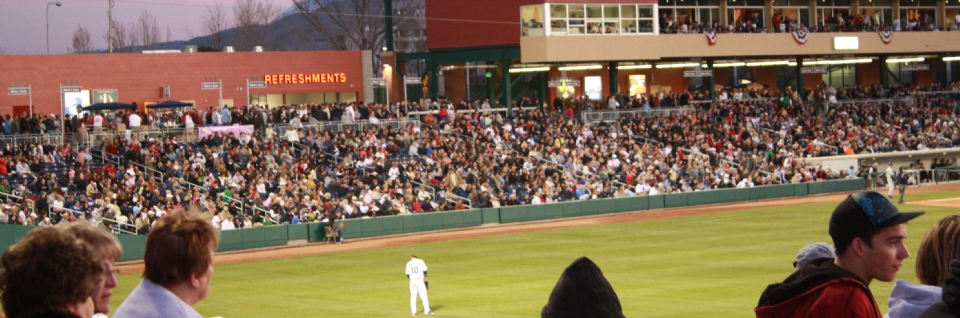
If you’ve watched Reno’s redevelopment-era ‘signature projects’ over the years, you know how these stories tend to go: ambitious visions, long horizons, detailed agreements, and periodic renegotiations when reality shows up with a calculator.
Next up: a new Reno Aces stadium amendment headed to the Reno Redevelopment Agency Advisory Board on January 26, 2026, and then the Reno Redevelopment Agency Board/City Council on the 28th, built around a term sheet that would supersede and replace all prior agreements.
The City’s pitch is simple (see what I did there?): extend the Aces’ stay, get the owners to invest more money downtown, and shift long-term stadium responsibilities off City Hall’s plate. The tradeoff is also simple: the City would hand over fee simple ownership of the stadium and land to StadiumCo and give up a couple of hard-power protections it currently has.
Below is the whole saga in three acts—2007, 2012/2013, and the new 2026 term sheet.
Act 1 (2007): The big, shiny redevelopment-era dream
The original 2007 package was not just “let’s build a ballpark.” It was “let’s build a ballpark and a district, and let redevelopment revenues cover a big chunk of the public commitment.”
The backbone agreements included:
- Ground Lease Agreement (9/21/2007) running to 6/1/2043
- Stadium Lease Agreement (9/21/2007) also to 6/1/2043
- A redevelopment-driven “Ballpark District” plan with parcel development obligations and revenue mechanics, including the Retail Development/Ballpark District Disposition & Development Agreement (DDA), which spelled out development requirements, land/parcel arrangements, and tax increment revenue payment obligations.
The not-so-subtle assumption: sales tax increment would gush forever
A later amendment to the stadium DDA (the Second Amendment, 3/25/2009) makes the “we’re counting on redevelopment revenue” assumption painfully clear by setting a minimum annual tax increment payment of $1,000,000 and tying it to specific district development commitments.
That’s the 2007 mindset in one line: build the thing, ignite the district, and let the district’s growth pay the bills.
Act 2 (2012/2013): The settlement—aka, “We need to stop pretending 2007 never ended”
By 2012/2013, staff describes the City’s position bluntly: economic conditions and market realities forced a restructure. But from what I remember, it was SK Baseball that forced the restructure, mentioning that because the Baseball Sales Tax District wasn't bringing in the anticipated sales tax revenue they were expecting, primarily because Sk Baseball/Simon did not build out the rest of the entertainment district as originally pitched and proposed in 2007, and thus, hardly any sales tax revenue was coming in. Sk Baseball stated to the Reno City Council/RDA Board back then that if the deal was restructured, the Reno Aces would be forced to leave.
That restructure did three major things:
- Reduced the annual payment obligation
- Dissolved the retail DDA
- Clarified the City’s financial exposure if the team relocated
In other words, the “district redevelopment machine” part of the plan got unplugged, and Reno moved toward a more structured, predictable (and survivable) payment arrangement. Appendix A identifies the Settlement and Restructuring Agreement as executed 1/30/2013, running to 6/1/2043, with a Schedule A payment schedule from 12/1/2013 through 6/1/2043 totaling $30,040,700.
That number—$30.0407 million—is the spine of the post-settlement deal.
The structural problem it didn’t fully solve
Here’s the key issue staff flags as the reason we’re back here in 2026: the Aces’ non-relocation/operating commitment expires in April 2029, while the City’s lease/payment obligations extend to 2043.
That’s a gap wide enough to drive a moving truck through—and still have room for the mascot.
Act 3 (2026): The new term sheet—longer stay, $40M investment, and the City hands over the stadium
The term sheet going to the board on 1/26/26 is described as nonbinding, but it’s clearly the negotiated blueprint and I'm assuming at some point, after the signatures come, will be binding. .
Staff’s stated goal is to address the 2029 vs. 2043 mismatch, improve the City’s position, and induce additional downtown investment.
Now let’s get into the proposed key terms.
1) Non-relocation extension: keep the Aces in Reno through 2049
Right now, the commitment expires April 17, 2029. The proposal extends it 20 years, effectively to 2049. It closes the gap between the “must stay” clause and the long payment tail. In other words, Reno is trying to avoid paying into the 2040s for a team that isn’t here.
2) A $40,000,000 “Incremental Investment” requirement, with deadlines (and default teeth)
StadiumCo commits to invest at least $40,000,000 in new capital improvements on the stadium property and/or immediate vicinity. Deadlines matter here: 50% within 5 years, 100% within 10 years
And if they miss those milestones, it’s a default (subject to notice/cure/force majeure).
The term sheet explicitly allows the investment to include not just stadium improvements, but development like retail, office, hotel, entertainment, or other commercial/residential facilities, subject to normal zoning/building rules. This is the “downtown redevelopment” lever that the 2007 deal promised and the 2013 settlement largely abandoned. This time, it’s written as a hard minimum with milestone triggers. “No, really, this time we mean the district part.”
3) The biggest shift: the City conveys fee simple ownership of the stadium and land
The City would convey full fee simple title to the stadium improvements (Greater Nevada Field) to StadiumCo at closing. The City would also release reversionary/repurchase rights, including removing the City’s existing right to acquire the stadium for $1.00 in the event of relocation. The existing ground lease and stadium lease would be terminated. That’s a lot. The City is trading “we own it (or can take it back cheaply)” for “you own it, but we’ll enforce your promises with clawbacks and payment leverage.” Owning a stadium is expensive, so perhaps it's a good thing the City gives that up. The City definitely would not be able to sell it for the $30 million they will have invested into it byt the time the payment obligations are done, and the maintenance costs alone would be astronomical, just to use it as a public ballpark.
4) StadiumCo takes on operations and maintenance—City steps out (mostly)
After transfer, StadiumCo assumes responsibility for all operations, maintenance, repairs, and replacements, with no City subsidy other than the restructured payment obligation described later. The City is explicitly relieved of obligations to fund or perform maintenance or upgrades. Deferred maintenance is how “fun civic projects” become “future budget emergencies.”
5) The enforcement tool: clawback/reversion if StadiumCo doesn’t perform
If StadiumCo materially fails on core obligations (non-relocation, investment commitment, or maintaining MLB standards) and doesn’t cure after notice, the City can:
- stop future payments; and
- trigger a clawback/reversion remedy, requiring the stadium land and improvements revert back to the City (clean title), via automatic reversion or nominal repurchase option.
This is crucial because once the City hands over fee title, the clawback is what keeps the promises from becoming “nice intentions.”
6) Property taxes: StadiumCo pays, City supports partial reimbursement efforts
After restructuring, StadiumCo is responsible for real and personal property taxes “as required by Nevada law.” The City acknowledges a 2015 settlement with Washoe County that allows StadiumCo to seek reimbursement of a portion of those taxes through the Washoe County Stadium Authority—and agrees to support those applications. Staff materials also reference the Stadium Authority’s reimbursement rights (described as $100k annually for the Washoe County portion).
7) Anti-flip protection: the “Home Run Provision” profit-sharing if StadiumCo sells within 5 years
If StadiumCo sells the stadium property or there’s a change of control within five years, the City gets a one-time “Early Transfer Profit Sharing Payment” tied to an MAI appraisal and a “Base Appraised Value” at closing (land + stadium only).
City share declines by year:
- Year 1: 50%
- Year 2: 30%
- Year 3: 20%
- Year 4: 10%
- Year 5: 5%
- After Year 5: 0%
This is Reno’s “don’t immediately flip the public asset you just received” clause.
8) City use of the stadium: five days a year (with a fee)
The City can use the stadium up to five days per year for City-sponsored events, coordinated with the Club, paying a mutually agreed “reasonable use fee.” It’s not “free public asset” access, but it preserves some civic use. I think the current deal allows for 12 events, but I'm not sure the City is actually taking advantage of those anyway.
9) The Freight House District TID reimbursement: still flowing
The term sheet keeps the existing Freight House District Tourism Improvement District reimbursement structure in place for its remaining term. Staff notes it currently generates over $700,000 per year for StadiumCo and is viewed as stable support “without requiring new City expenditures.” Appendix A similarly indicates the 2010 TID reimbursement amendment stays in place “for life of TID.”
10) Transfers allowed, but obligations must follow the asset
StadiumCo and the Club can transfer ownership interests, but successors must assume obligations—especially the non-relocation covenant and investment commitment. This is important because sports teams often change hands, and “don’t worry, the next owner will be cool” is not an enforceable legal standard.
11) Naming rights belong to StadiumCo
All stadium naming rights belong to StadiumCo; it controls negotiations and keeps the revenue..
12) If the City misses a payment, StadiumCo’s commitments can vanish—but the City still owes the money
Here’s the sharpest edge in the whole term sheet. If the City fails to make an annual installment payment (including non-appropriation) and doesn’t cure after notice, then all StadiumCo/Club commitments are released—including non-relocation, the investment obligation, City-use rights, reversionary interests, etc.—but the City’s remaining payment obligation survives in full. That's more of a gym membership contract than a partnership. I get that Sk Baseball/Simon wants guarantees, but maybe this can be softened a bit.
13) The $1,000,000 annual payment continues, but shifts entirely to the Redevelopment Agency (not the General Fund)
The term sheet confirms that the City currently makes a $1,000,000 annual contribution to StadiumCo and proposes continuing it as the sole obligation of the Reno Redevelopment Agency, treated as a senior/priority obligation. Staff’s explanation is the budget-policy angle: today the agreement indicates the General Fund backs the obligation if the RDA can’t; this would de-obligate the General Fund and place the remaining obligation entirely on the Redevelopment Agency. It’s a firewall—at least on paper—between stadium payments and the General Fund.
The four primary benefits to the City to me are huge;
- Close the mismatch gap: non-relocation currently ends in 2029 while obligations extend to 2043; the new deal pushes the stay to 2049.
- Shift future cost risk: StadiumCo becomes responsible for maintenance/repairs/upgrades; the City is relieved of those obligations.
- Force new downtown investment: $40M minimum, with 5- and 10-year milestone deadlines and default consequences.
- Reduce General Fund exposure: shift the obligation fully onto the Redevelopment Agency.
The staff report also points to the Aces’ economic footprint—“hundreds of thousands of people downtown,” 119+ jobs, ~$8.2M in labor income, and ~$21.9M in annual spending output, plus $10M+ in stadium improvements since 2022.
That’s the core of it: keep a downtown anchor, keep the crowds, force additional private investment, and stop the City from owning a long-term maintenance obligation.
Key Questions to Ask
This is the part where people should stop arguing about whether baseball is “good vibes” and start reading the enforcement clauses.
The key questions:
- Is the clawback actually airtight? It’s the main substitute for City ownership after the fee-title transfer.
- How will the $40M investment be verified and enforced? The milestones exist; the details of what qualifies and how it’s audited will matter.
- Does the City nonpayment clause get softened? As written, it’s lopsided: City still owes, team obligations evaporate.
- Is the “RDA-only” payment structure truly insulated? The term sheet aims to move risk off the General Fund, but the practical impact depends on RDA revenues and prioritization.
If the City gets the enforcement right—especially around investment milestones and the payment/default symmetry—it can plausibly argue this amendment swaps a fragile old structure for a more durable, performance-based deal.