
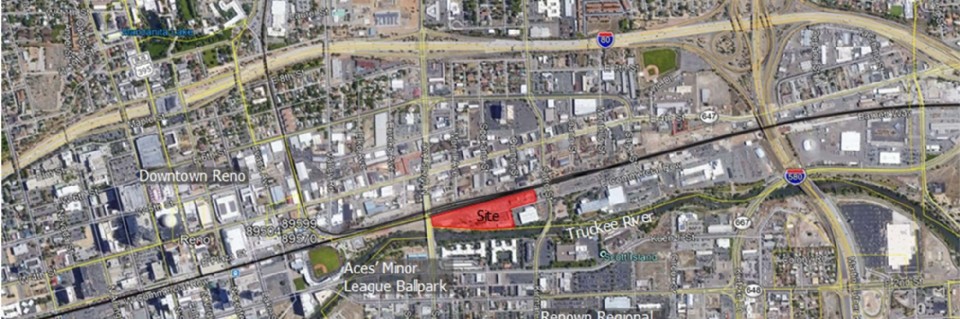
An infill redevelopment proposal is headed to the Reno Redevelopment Agency Board on Wednesday, October 3, and this one could reshape a long-neglected stretch of riverfront east of downtown. The developer—E. Commercial Row LLC (Valeo)—is seeking up to $3,238,000 in Tax Increment Financing (TIF) to help pay for the public-facing infrastructure needed to make a 200-unit townhome project possible along the Truckee River and Union Pacific Railroad corridor.
The project covers 8.49 acres across multiple parcels between Sutro Street and the Wells Avenue Bridge, backed by the UPRR tracks and fronting roughly 1,200 feet of Truckee River shoreline. Today, the area is a patchwork of gravel lots, derelict industrial edges, and one crumbling structure. According to the packet, the site sees frequent homeless encampment, dumping, and safety issues.
Here's a project breakdown:
- Build 200 rental townhomes (1-, 2-, and 3-bedroom units).
- Add garages and surface parking (424 spaces).
- Install community amenities including green space, riverfront recreation areas, a pool, and trail connections.
- Create a “real neighborhood,” with porches, parkways, pedestrian paths, and both two- and three-story homes.
The project is framed as an anchor piece in pushing downtown residential living eastward toward the ballpark and improving public access to the Truckee River trail network.
The TIF request is exclusively for public improvements, not for private construction. These are items the City considers to have broader public benefit and that also fix longstanding infrastructure weaknesses in the corridor. The improvements come directly from the Developer’s detailed site budgets and are broken into seven categories:
1. Commercial Row Street Extension – $806,261
Regrading, paving, sidewalks, lighting, curbs, and extending the right-of-way so Commercial Row properly connects through to the Aces’ ballpark access roads.
2. UPRR Edge Retaining Wall & Drainage – $722,869
Includes a long linear retaining/acoustic wall, drainage fixes, fencing, and earthwork to stabilize the deteriorating railroad embankment.
3. River Trail Edge Improvements – $966,302
Rock revetments, path grading, DG and concrete trail surfaces, stairs, railings, benches, picnic areas, lighting, landscaping, and erosion control along the Truckee River trail.
4. TMWA Access & Edge – $119,702
Screening walls, landscaping, and access improvements around the TMWA monitoring facility located on-site.
5. Waste Management Access & Edge – $197,450
New screening walls, driveway upgrades, fencing, and landscaping along the Waste Management property line.
6. Sutro–Commercial Row Entry & Parkways – $158,677
Gateway improvements: monument walls, sidewalks, trees, lighting, traffic-recommended upgrades, and landscaping at the project’s primary entry.
7. City River Trail Extension – Aces Edge – $147,026
Completes the missing trail link toward the ballpark and Wells bridge area.
Total eligible improvement cost: $3,238,287, nearly identical to the TIF request.
Why the City Says This Meets the “But-For” Test
The Redevelopment Agency’s consultant—SB Friedman Development Advisors—ran the required financial gap analysis. The key conclusion according to SB Friedman:
The project does not pencil out at market-standard investor returns without TIF assistance. SB Friedman identified extraordinary costs that are unique to this site:
- Riverfront stabilization and trail reconstruction
- Major walls and screening along the railroad
- Infrastructure reconfiguration including a cul-de-sac, new ROW, and drainage
- Fees and utility adjustments that are unusually high for a residential project
The numbers
Total project cost: $73.7M
Total increment the project would generate through 2035: ≈ $3.238M
IRR without TIF: 13.6% (below the required ~15% hurdle)
IRR with full TIF: 14.7% (within competitive range)
In other words, the project can generate the amount of TIF it is asking for—but only if it moves forward. Without assistance, the developer would not meet return thresholds to attract equity partners.
Deal Structure: How the TIF Would Be Repaid
Like with all TIF deals, the developer fronts the cost of public improvements.
After the project is built and reassessed, the City collects the new tax increment. The Agency reimburses the developer from that increment. Only the new taxes generated by the project are used—no General Fund money is involved. The district sunsets in 2035, so the reimbursement window is limited. The City retains a 1% administration fee on the increment.
The staff report suggests the Agency may choose a reimbursement rate in the 90–100% range due to the short remaining lifespan of RDA Area 2.
According to the packet and site exhibits, the project does the following:
- Improves river access and extends the trail network west toward Greater Nevada Field.
- Cleans up a blighted industrial corridor.
- Adds hundreds of new residents to downtown’s edge.
- Provides new landscaped buffers, sound walls, and safety features.
- Reduces encampment and fire risk by reactivating long-vacant land.
- Improves public edges used by TMWA, Waste Management, and the City.
Project Timeline
Based on the developer’s schedule and staff report milestones:
Planning & Approvals
Preliminary site plan approval: Q3 2025
Site & building permits: Q2 2026
Construction
Construction start: Q3 2026
Site work, grading, infrastructure: late 2026
Vertical construction: 2027–2028
Completion & Leasing
Initial occupancy: Q3 2027
Full stabilization: mid-2028
If approved on October 3, the TIF agreement (OPA) would finalize once financing closes and improvement costs are verified.